What Is the Difference Between Editing and Proofreading?
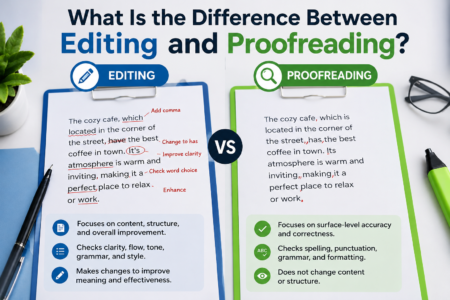
People use these words interchangeably. They should not. Editing and proofreading are different stages of the writing process, they serve different purposes, and confusing one for the other is one of the most expensive mistakes a first-time author can make.
Here is what each one actually means, why the order matters, and how to know which one your manuscript needs right now.
Editing Comes First and Goes Deeper
Editing is about the manuscript as a whole. It looks at structure, argument, pacing, clarity, voice, and whether the book actually works as a reading experience. An editor is not looking for typos. They are asking whether your chapters are in the right order, whether your argument builds logically, whether your characters are consistent, whether your reader will still be engaged on page 200.
There are different levels of editing and they are not interchangeable.
Developmental Editing
This is the deepest form of editorial work. A developmental editor looks at the big picture. Architecture. Whether your book’s central idea is clearly articulated. Whether the structure serves that idea. Whether sections drag or feel rushed. Whether the reader has what they need at each stage to follow the narrative.
Developmental editing often results in significant restructuring. Chapters get moved, cut, or rewritten. This is normal. It is also why developmental editing happens first, before any other stage of the process.
Line Editing
Line editing works at the paragraph and sentence level. The structure of the book has already been addressed. Now the editor focuses on how each sentence reads. Clarity. Flow. Whether the language is doing what you intend it to do. Whether your voice is consistent throughout.
Line editing is not about grammar rules. It is about whether your prose communicates effectively and reads well. A line editor might rewrite a sentence entirely, not because it was grammatically wrong, but because it was unclear, clunky, or just not working.
Copy Editing
Copy editing is the final editorial pass before proofreading. It catches grammar, punctuation, syntax, and consistency errors. It also checks for internal inconsistencies across the manuscript. A character whose eyes were blue in chapter two and brown in chapter fourteen. A statistic cited differently in two separate sections.
book editing services typically offer all three levels as separate or bundled services depending on what the manuscript needs.
Proofreading Is the Last Step, Not the Only Step
Proofreading assumes the book is finished. The structure is right. The sentences work. The content is final. Now someone reads the manuscript specifically to catch errors that slipped through everything else. Spelling. Punctuation. Formatting inconsistencies. Widows and orphans in the layout.
Proofreading is not a substitute for editing. This is the mistake. Authors who skip editing and go straight to proofreading end up with a grammatically correct manuscript that does not work as a book. The sentences are clean. The structure is broken. Readers notice.
A book proofreading service is the final quality gate before publication, not the only quality gate.
The Right Order Every Time
Developmental editing first. Line editing second. Copy editing third. Proofreading last.
Skipping stages to save money or time creates problems that cost more to fix later. A manuscript that goes to a copy editor before developmental editing might be restructured after copy editing, undoing all that work. A manuscript that goes straight to print after only proofreading will carry structural and stylistic problems that no amount of clean grammar can fix.
Which One Does Your Manuscript Need Right Now
If you have a first or second draft, you need developmental editing. Full stop.
If your structure is solid but the writing feels uneven or unclear in places, you need line editing.
If the writing is strong and you just need a final consistency and grammar check before sending to a copy editor or formatter, you need copy editing.
If your manuscript is completely finished, designed, and formatted and ready to go to print or upload, you need proofreading.
When in doubt, get a developmental edit first. It is always easier to fix the structure before the prose is polished than after.
A Note on AI Editing Tools
Grammarly, ProWritingAid, and similar tools catch surface errors. They do not replace any stage of professional editing. They are useful for a quick self-review before submitting your manuscript to a professional, but they cannot assess structure, voice, pacing, argument, or any of the deeper elements that determine whether a book actually works.
Use them as a supplement. Not a substitute